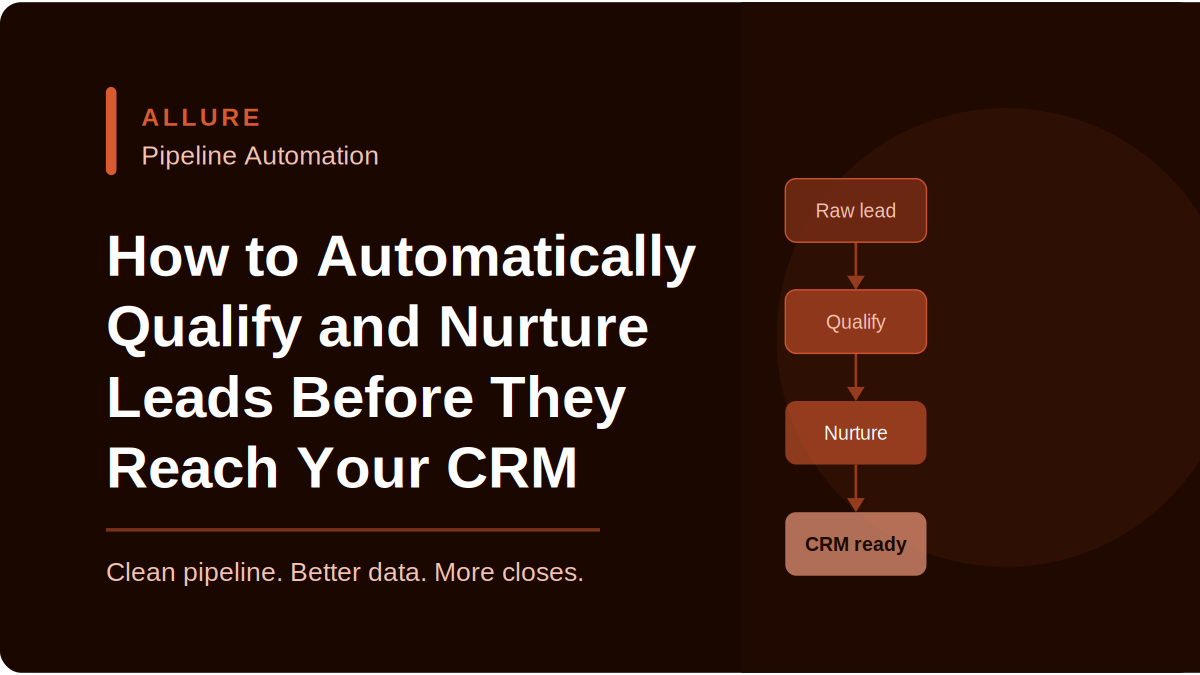
Speed-to-Lead: Why Responding in 5 Minutes Decides Whether You Win the Deal
Every lead that fills out your form is, for a few short minutes, the most interested they will ever be in your business. Then the moment fades. They open another tab, compare three competitors, get pulled into a meeting — and the window closes.
This is the hidden tax on almost every sales team: not a shortage of leads, but a delay in responding to the ones they already have. The discipline of closing that gap has a name — speed-to-lead — and it's quietly one of the highest-leverage things you can fix in your entire sales process.
What "speed-to-lead" actually means
Speed-to-lead (sometimes called lead response time) is the elapsed time between a prospect raising their hand — submitting a form, requesting a quote, replying to an ad — and your first meaningful response reaching them.
It's not the same as "how fast you send an autoresponder." A generic "Thanks, we'll be in touch" doesn't count for much. What moves the needle is a real, relevant, two-way response: answering their question, asking a qualifying one, or offering a time to talk.
Why the first five minutes matter so much
The research on response timing has been remarkably consistent for over a decade, and the headline findings are widely cited across the sales industry:
- Contacting a web lead within five minutes versus thirty minutes can make you many times more likely to actually connect with and qualify that lead. Wait an hour and the odds drop sharply.
- A large share of buyers simply go with whoever responds first. When several vendors look roughly equal, "they got back to me right away" becomes the tiebreaker.
- Lead interest is perishable. The intent that drove someone to fill out a form at 9:14 a.m. is largely gone by the afternoon.
Worth noting: pull the original sources (the Lead Response Management Study, Harvard Business Review's "The Short Life of Online Sales Leads," and your own CRM data) and link them in the published version — first-party numbers and cited studies both build trust and help SEO.
The mechanism is simple. Fast response catches the prospect while the problem is still top of mind, before competitors enter the picture, and before life gets in the way. Slow response means you're now interrupting someone about a problem they've half-forgotten — or already solved with someone else.
The real reasons teams respond slowly
Almost no one intends to be slow. The delay comes from structural gaps:
- After-hours and weekends. A huge portion of leads arrive when no human is at a desk. By Monday they're cold.
- The handoff lag. A form fills out, a notification fires, someone eventually sees it, looks up the record, drafts a reply. Each step adds minutes or hours.
- Uneven follow-up. Reps chase the leads that look easy and let the rest sit. The "maybe" pile never gets worked.
- Volume spikes. A good campaign floods the inbox, and the team simply can't keep up manually.
None of these are motivation problems. They're capacity and timing problems — which is exactly why automation solves them so well.
How to actually shrink your response time
You don't need to rebuild your whole sales motion. A few moves capture most of the gain:
1. Respond instantly, every time — including 2 a.m.
The goal is a relevant first response within minutes of any inbound lead, around the clock. Humans can't do this consistently; an always-on system can.
2. Make the first touch a conversation, not a confirmation
Instead of "We received your request," open a genuine exchange: confirm what they need, answer the obvious first question, and ask one qualifying question back. Engagement beats acknowledgment.
3. Route hot leads to a human while they're still warm
Automation should qualify and engage instantly, then hand a sales-ready, context-rich prospect to a rep — ideally with a meeting already on the calendar.
4. Measure it
Track median response time, not the average (a few fast replies hide a lot of slow ones). Watch it by source, by hour, and by rep. What gets measured gets fixed.
Where AI changes the math
This is where an AI sales assistant fundamentally rewrites the economics of speed-to-lead. Instead of asking your team to be faster — which has a hard human ceiling — you remove the wait entirely.
Allure engages every new lead the moment it arrives, 24/7, with a real AI-driven conversation that qualifies the prospect, handles common questions, and books the meeting straight into your calendar. By the time a human is involved, the lead is warm, qualified, and scheduled — and the whole exchange syncs into your CRM automatically.
The result is the thing slow-responding competitors can't match: you're always the one who got back to them first.
See your own response time in action. Book a free Allure demo and watch an AI agent engage and qualify a lead in real time — or start a free trial and point it at your next inbound lead.
Frequently asked questions
What is a good speed-to-lead time? Aim for under five minutes for inbound web leads. Many top-performing teams respond in under a minute using automation, while the industry average still stretches into hours.
Does responding fast really increase conversions? Consistently, yes. Faster first contact improves your odds of reaching the lead, beats competitors to the conversation, and catches the prospect while intent is highest.
Can I respond instantly without hiring more people? That's exactly what AI sales assistants are built for — instant, around-the-clock first responses and qualification without adding headcount.
Won't an instant automated reply feel robotic? Only if it's a generic autoresponder. A modern AI agent holds a relevant, two-way conversation, answers questions, and adapts — which is why it converts where canned replies don't.
Stop letting your best leads go cold. Try Allure and respond to every lead in seconds, day or night.
