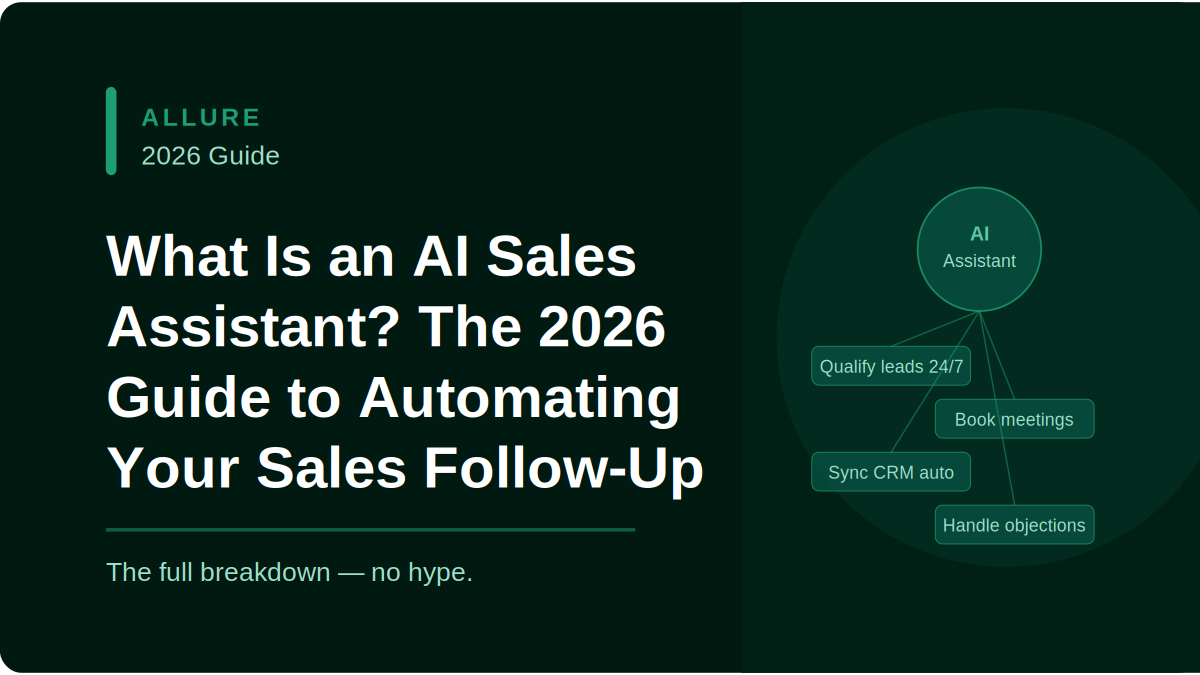
What Is an AI Sales Assistant? The 2026 Guide to Automating Your Sales Follow-Up
For most of sales history, there was a hard ceiling on growth: the number of conversations your team could physically have in a day. More leads meant more reps, more salaries, more management. That equation is now breaking — and the thing breaking it is the AI sales assistant.
If you've heard the term and weren't sure whether it's real or hype, this guide is the straight answer: what an AI sales assistant actually does, where it fits in your pipeline, and how to tell whether it's right for your business.
What is an AI sales assistant?
An AI sales assistant (also called an AI sales agent or AI SDR) is software that can hold real, two-way conversations with your prospects — qualifying them, answering questions, handling objections, and booking meetings — without a human driving each message.
Think of it less as a chatbot and more as a tireless first-line rep that works every lead, instantly, at any hour, and never forgets to follow up. It picks up the moment a lead arrives, carries the conversation as far as it usefully can, and hands a warm, qualified prospect to your human team.
The key difference from old-school automation: traditional tools send pre-scheduled blasts on a fixed timeline. An AI sales assistant responds — it reads what the prospect said and replies in context, the way a person would.
What an AI sales assistant actually does
The strongest platforms cover the whole top of the funnel:
- Instant lead engagement. Every inbound lead gets a real response within seconds, 24/7 — no nights-and-weekends gap.
- Lead qualification. It asks the right questions to separate genuine buyers from tire-kickers, so reps spend time only on prospects worth their time.
- Objection handling. Common questions about price, timing, fit, and process get answered immediately instead of stalling the conversation.
- Meeting booking. When a lead is ready, it offers times and drops the appointment straight onto the right calendar.
- Multi-channel follow-up. It nurtures across email, SMS, and chat, picking up dropped threads and re-engaging quiet leads automatically.
- CRM sync. Every interaction is logged and pushed into your CRM, so your pipeline stays accurate without manual data entry.
Why this matters now
Three pressures are converging in 2026 to make this a mainstream tool rather than an experiment:
Buyers expect instant responses. People research and buy on their own schedule, often outside business hours, and they reward whoever replies first. Human-only teams structurally can't meet that expectation.
Sales costs keep rising. Hiring, ramping, and retaining SDRs is expensive and slow. An AI assistant scales conversation capacity without scaling headcount.
The technology finally works. Modern language models hold natural, context-aware conversations that customers don't find frustrating — a genuine break from the rigid chatbots of a few years ago.
What it costs you to not have one
The cost of inaction is invisible, which is what makes it dangerous. Every week without instant, consistent follow-up, you're quietly losing:
- Leads that went cold because no one replied in time.
- After-hours and weekend inquiries that never got worked at all.
- "Maybe" leads that a busy rep never circled back to.
- Rep hours burned qualifying prospects who were never going to buy.
These don't show up as a line item — they show up as a pipeline that's smaller than your lead volume should produce.
What an AI sales assistant is not
To set expectations honestly:
- It's not a full replacement for your sales team. It handles the repetitive, time-sensitive top of the funnel so your people can focus on closing and relationships.
- It's not "set and forget" on day one. Like a new hire, it needs proper setup and a bit of monitoring early on to match your voice, offers, and qualifying criteria.
- It's only as good as your inputs. Clean CRM integration and a clear sales process make the difference between great results and mediocre ones.
A good vendor will be upfront about all of this. Be wary of anyone promising magic with zero setup.
How to know if you're ready for one
You're a strong candidate if you recognize most of these:
- You get more inbound leads than your team can respond to quickly.
- A meaningful share of leads arrive outside business hours.
- Follow-up is inconsistent — some leads get five touches, others get one.
- Reps spend significant time qualifying leads that go nowhere.
- You want to grow pipeline without immediately growing headcount.
If three or more of those describe you, the math almost always favors automating the first response.
Getting started
You don't need to overhaul your stack. The fastest path:
- Pick your highest-volume lead source (the one most likely to go cold) and start there.
- Define your qualifying questions — what makes a lead "sales-ready" for you.
- Connect your CRM and calendar so qualified leads and booked meetings flow automatically.
- Monitor the first couple of weeks, tune the conversations, then expand to more sources.
Allure is built exactly for this — an AI sales assistant that engages, qualifies, and books your leads around the clock, then syncs everything into your CRM. Book a free demo to see it work on a live lead, or start a free trial and let it handle your next inbound inquiry.
Frequently asked questions
What's the difference between an AI sales assistant and a chatbot? A basic chatbot follows scripted rules. An AI sales assistant holds natural, context-aware conversations — qualifying, handling objections, and booking meetings — and adapts to what the prospect actually says.
Will an AI sales assistant replace my sales reps? No. It automates the repetitive, time-sensitive top of the funnel — instant response and qualification — so your reps spend their time on higher-value selling and closing.
How quickly can it start working? With CRM and calendar integration in place, many businesses are engaging leads within days. Expect a short tuning period to match your voice and qualifying criteria.
Does it work outside business hours? Yes — that's one of its biggest advantages. It engages and qualifies leads 24/7, including the nights and weekends when human teams are offline.
Ready to stop losing leads to slow follow-up? Try Allure and put an AI sales assistant to work on your pipeline.
